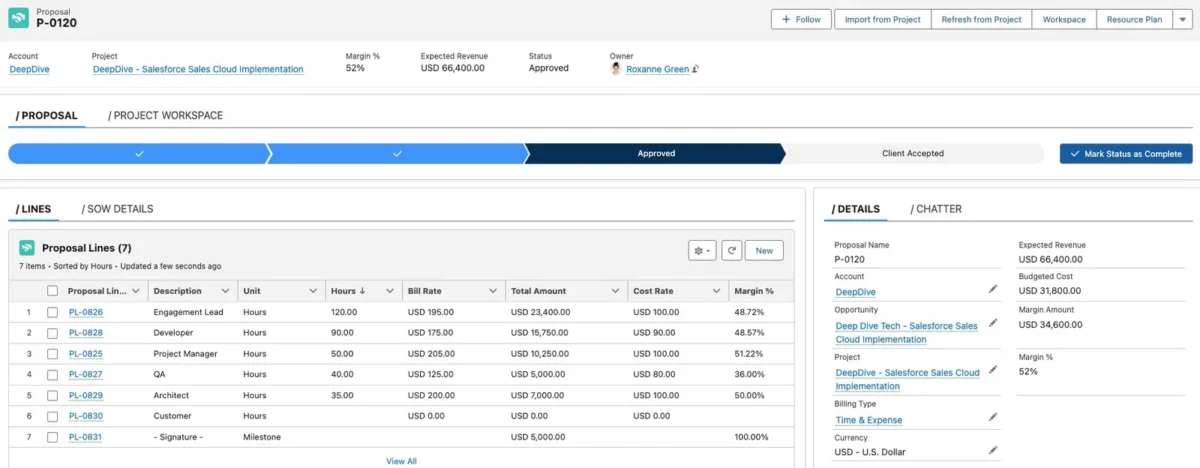
The sales-to-delivery handoff is the moment a signed deal becomes a live project — when the account, scope, and budget your sales team sold have to reach the delivery team who will execute them. On most CRMs this is where the data stops: the opportunity closes, and everything downstream — the project plan, the resourcing, the timesheets, the invoices — starts over in a different tool. A Salesforce PSA closes that gap by turning the closed opportunity directly into a project on the same platform, so nothing is re-keyed and nothing is lost in translation.
This guide explains why the handoff breaks in most firms, what a clean handoff looks like step by step, which data should carry across, and how to set it up so margin stops leaking at the seam between sales and delivery. (New to the platform layer? Start with What Is Salesforce PSA?)
Why the sales-to-delivery handoff breaks
In a services firm, the handoff is the single most expensive seam in the business, because it is where the promise made during the sale meets the reality of delivery. It breaks for a structural reason: the CRM records why the deal was won and what was sold, but a standalone project tool starts from a blank plan. Between them sits a manual re-entry step — someone reads the quote, interprets the scope, and rebuilds it as tasks and budgets by hand.
That gap produces the failures every delivery leader recognizes:
- Scope drift — what sales sold and what delivery planned quietly diverge, because they live in two systems that never reconcile.
- Margin leakage — the budget in the quote and the budget in the project don’t match, so overruns aren’t visible until the engagement is already underwater.
- Slow starts — the project can’t be resourced until someone rebuilds it, so billable work waits on administration.
- No single source of truth — executives can’t see, in one place, what was sold versus what is being delivered versus what is being billed.
What a broken handoff costs
The gap is not just administrative friction — it has a price, and it compounds. Three costs recur in every firm running sales and delivery on separate systems:
- Unbilled, under-scoped work. When the plan is rebuilt by hand, change orders and add-ons captured in the quote get missed — so hours are delivered that were never budgeted, and never billed.
- Delayed revenue. Every day a closed deal waits to be rebuilt as a project is a day of billable capacity sitting idle. Across a portfolio, a few days per engagement is weeks of lost utilization a quarter.
- Blind margin. If the sold budget and the delivery budget live in different tools, no one sees an overrun until reporting reconciles them — usually after the money is already spent.
None of these show up as a line item; they surface as the quarter that came in below forecast for reasons nobody can fully explain. A clean handoff makes each of them visible at the moment it happens.
What a clean Salesforce handoff looks like
On a Salesforce-native PSA, the handoff is not a re-entry step — it is a conversion. When the opportunity reaches Closed-Won:
- The opportunity becomes a project. Automatically or from a template, the project inherits the account, contacts, sold scope, and budget from the opportunity — no retyping, no interpretation gap.
- Quote lines become tasks and budgets. What sales sold becomes the structure delivery executes against, so the plan starts aligned with the contract instead of drifting from it.
- The project is resourced immediately. Because the plan exists the moment the deal closes, resource managers assign consultants by skill and availability without waiting on a rebuild.
- Time and billing run against the same record. Consultants log time against the tasks that came from the quote; invoices generate from approved time — fixed-fee, milestone, retainer, or time-and-materials — with no export to a separate billing system.
The result is one continuous thread from pipeline to paid invoice, all inside Salesforce. The executive who watched the deal in the pipeline can watch its margin in delivery, in the same reports.
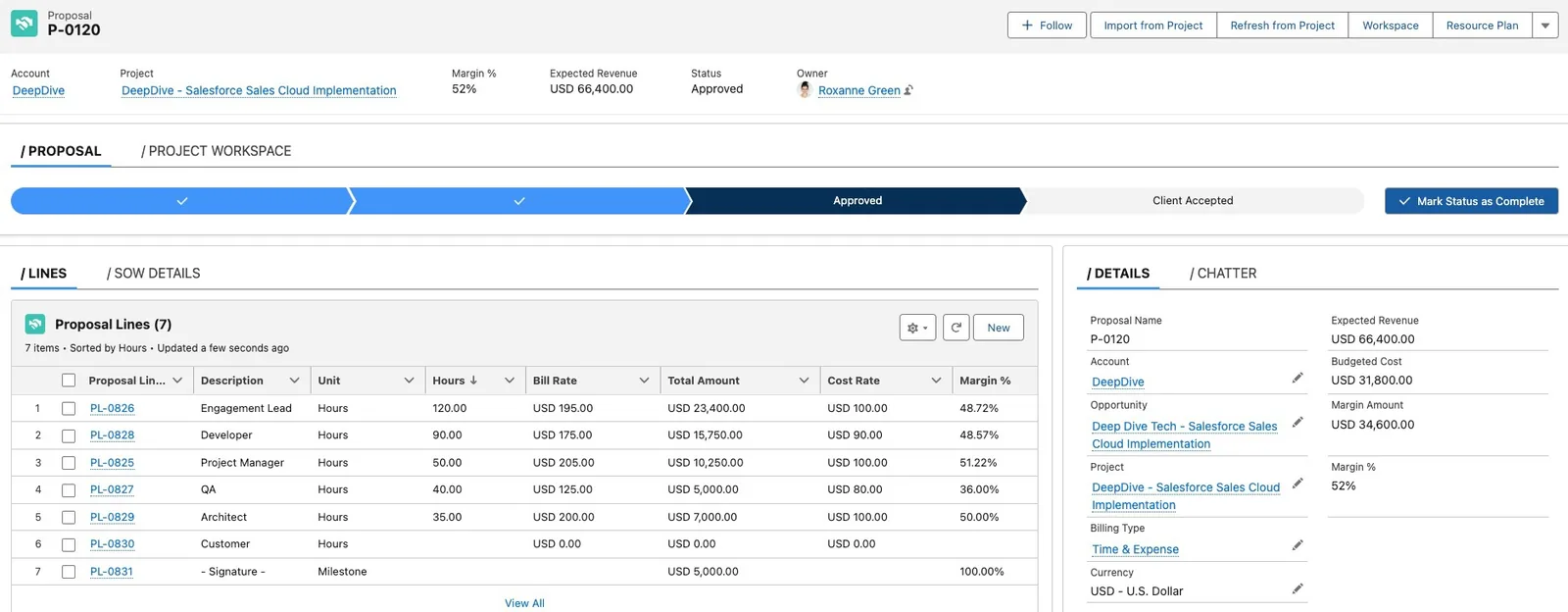
What data should carry across the handoff
A well-configured handoff maps each piece of the sold deal to the delivery record that needs it. This is the mapping a native PSA automates:
| From the sale (CRM) | To delivery (PSA) | Why it matters |
|---|---|---|
| Opportunity | Project | One record links pipeline to delivery; reporting spans both. |
| Account & contacts | Project stakeholders | Delivery works from the same relationships sales built. |
| Quote / opportunity line items | Tasks, phases & budgets | Delivery executes exactly what was sold; scope is traceable. |
| Contract value & billing model | Project budget & billing schedule | Margin is measurable from day one; invoices match the contract. |
| Close date | Project start / kickoff | Resourcing and timelines trigger without manual scheduling. |
Why the handoff exposes the native advantage
Every PSA claims to connect sales and delivery. The difference is whether that connection is a shared database or a sync across an API. With an integrated (non-native) PSA, each step of the handoff crosses a boundary where data can lag, fail, or disagree — and reconciling the two systems becomes a permanent tax. With a native PSA, the opportunity and the project are records in the same org, so there is no boundary to cross and nothing to reconcile. The handoff is the clearest place to see why native matters — the full comparison is here: Salesforce PSA — Native vs Integrated.
How to set up the handoff
Three configuration choices make the handoff automatic rather than manual:
- Project templates by engagement type. Define a template per offering (implementation, retainer, assessment) so a closed deal spawns the right task structure instantly.
- Opportunity-to-project automation. Trigger project creation on Closed-Won with the right owner, so no deal waits in a queue for someone to notice it.
- Quote-line mapping. Map product/quote lines to task groups and budget lines so the sold scope lands as the delivery plan, not a blank one.
Klient PSA ships this as its opportunity-to-project flow; it’s a standard part of a typical three-week go-live.
Where AI fits into the handoff
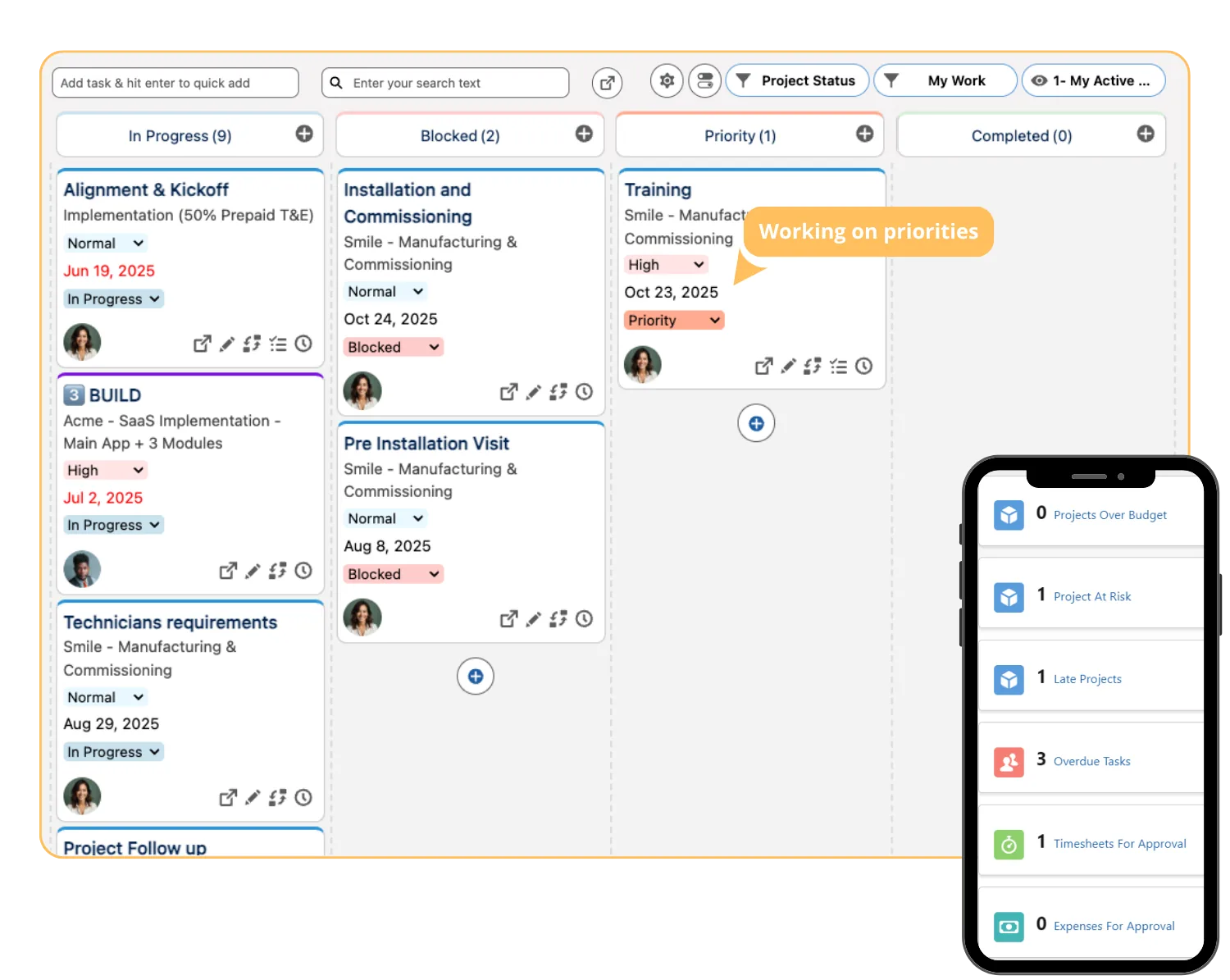
Because the sold scope and the project plan live on the same platform, AI agents can act on the handoff itself. On Klient PSA, Agentforce agents can draft the initial scope from the closed opportunity, stand up the project plan, and prepare the kickoff — with a human reviewing and approving every output before it reaches the client. It turns the slowest, most error-prone administrative step in the firm into a reviewed, minutes-long one. That operating model — humans lead, agents deliver — is Hybrid Project Delivery.
FAQ
What is the sales-to-delivery handoff?
It’s the transition from a signed deal to an active project — moving the account, sold scope, and budget from the sales team to the delivery team. On a Salesforce PSA, the closed opportunity converts directly into a project, so nothing is re-entered.
How does an opportunity become a project in Salesforce?
A Salesforce PSA converts a Closed-Won opportunity into a project — automatically or from a template — carrying the account, quote lines, and budget into the project’s tasks and financials on the same platform.
Why do sales-to-delivery handoffs fail?
They fail when sales and delivery run in separate systems, forcing manual re-entry of the sold scope. That gap causes scope drift, margin leakage, and slow project starts. A native PSA removes the re-entry step.
What data should transfer from the opportunity to the project?
The account and contacts, the quote or opportunity line items (as tasks and budgets), the contract value and billing model, and the close date — so the delivery plan matches exactly what was sold.
Does the handoff work better on a native Salesforce PSA?
Yes. On a native PSA the opportunity and project are records in the same org, so there’s no API sync to lag or fail. On an integrated PSA the handoff crosses a system boundary that must be built and maintained.
Ready to fix the seam between sales and delivery? See how Klient PSA works, review pricing, or book a demo.