Salesforce platform · Explained · Updated 8 September 2026
Salesforce Headless 360
Every capability on the platform, callable without a browser.
60+ MCP tools
Built for AI clients
Salesforce made the platform browserless. Here is what that changes.
What it is
Salesforce Headless 360 is Salesforce’s browserless architecture: every capability on the platform is reachable as an API, an MCP tool or a CLI command, so an AI client can act on your org directly instead of a person clicking through screens. The platform stops requiring a front end.
What shipped
Announced at TDX 2026
Everything is an interface
Every capability is exposed three ways — as an API, as an MCP tool, or as a CLI command. Nothing on the platform is reachable only by clicking.
60+ MCP tools, 30 coding skills
Salesforce shipped more than sixty new MCP tools and more than thirty preconfigured coding skills, so an AI client can perform real platform work rather than just read from it. The Headless 360 MCP Server went to beta in July 2026.
Aimed at the AI clients people already use
Built to be driven from Claude Code, Cursor, Codex and Windsurf — the tools developers and admins already work in, rather than a new Salesforce surface to learn.
Say it precisely
“Headless” means two different things right now
Both are real, they are not the same axis, and conflating them is why the word is going mushy. One is about the platform. The other is about how delivery work moves.
| Headless platform | Headless delivery | |
|---|---|---|
| The name | Salesforce Headless 360 | Headless Project Delivery |
| What it removes | The browser. Every object, action and automation is callable. | The queue. No one waits for a person to be free. |
| Kind of claim | Architecture — what the software can be driven by. | Delivery model — how work reaches the client. |
| Who acts | An AI client, calling the org directly. | Agents execute; your experts direct and approve. |
| Where the client sits | Unchanged — it is a platform property. | Inside the project itself, not on a status report. |
| Whose choice | Salesforce shipped it. | A choice your firm makes about how it works. |
Read the table in one direction only: a headless platform is what makes headless delivery possible — it does not deliver it. The platform being callable is a precondition; the delivery model is a choice a firm makes about how it works.
The part nobody is writing about
What it means for a services firm
Most of the Headless 360 coverage is written for developers and admins. The consequence for a firm that delivers projects for a living is bigger, and it is simple:
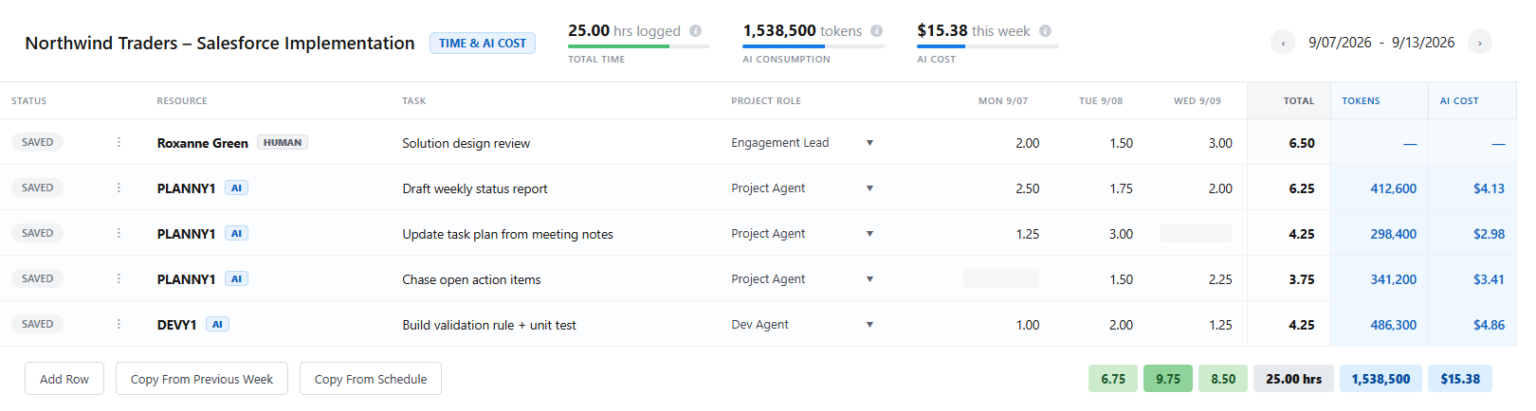
That last one is the part most firms have not solved. An agent that does delivery work but whose cost lands nowhere near the project makes margin fiction. In Salesforce PSA terms, an agent has to be a resource — assigned, scheduled, and logging what it consumed.
Dreamforce 2026 · September 15–17 · Moscone Center, San Francisco
What to watch
Headless has its own keynote this year, which tells you how hard Salesforce is pushing it. As of 10 September 2026, these are the three things worth your attention:
Headless 360 runs as a theme across the whole event rather than as a single announcement, which is the clearest signal of how central it has become. Claudeforce points the same way: the platform driven from an AI client rather than from its own interface.
Where we fit
We shipped headless before it was a keynote
Klient PSA runs natively on Salesforce, and MCP1 is a headless interface into it: an AI client can read and act on projects, tasks, timesheets and resources without opening the app. That is Headless 360’s own definition of headless, applied to project delivery rather than to the core platform.
Klient PSA is the Salesforce-native PSA for professional-services firms of 50 to 1,000 people — project delivery, resourcing, timesheets and billing on the same Salesforce org as the CRM, from $39 per user per month with the Salesforce licence included. It is rated 4.96/5 on the Salesforce AppExchange.
Alongside it, nine Agentforce agents — PLANNY1, TIMEY1, SCOPEY1, STAFFY1, CASEY1, GUIDY1, TOUCHY1, DEVY1 and KNOWWY1 — work as resources on real projects: assigned to tasks, scheduled, supervised, and reviewed by a person before anything reaches a client.
The delivery model this enables
We call it Headless Project Delivery: the customer drives the project from the inside, AI agents do the execution, and your experts direct and approve. Headless Project Delivery →
Questions
Salesforce Headless 360, answered
What is Salesforce Headless 360?
Salesforce Headless 360 is Salesforce’s browserless architecture: every capability on the platform is reachable as an API, an MCP tool or a CLI command, so an AI client can act on your org directly instead of a person clicking through screens. It was announced at TDX 2026 and includes more than sixty new MCP tools and more than thirty preconfigured coding skills.
When did Salesforce Headless 360 launch?
It was announced at TDX 2026 in April 2026. It has its own keynote at Dreamforce 2026 (September 15–17, Moscone Center, San Francisco) — “Anywhere Humans and Agents Work” — along with a published Trail Map for attendees following the theme across the event.
What are the Salesforce MCP tools in Headless 360?
MCP — Model Context Protocol — is the standard that lets an AI client call an external system’s capabilities directly. Headless 360 ships more than sixty Salesforce MCP tools plus thirty preconfigured coding skills, designed to be used from AI clients such as Claude Code, Cursor, Codex and Windsurf. In practice it means an AI client can perform real work in your org rather than only reading data out of it.
Does headless mean Salesforce has no user interface?
No. The interface still exists and people still use it. Headless means the interface is no longer required — anything you could do by clicking can also be done by a call. The point is not removing the screen; it is that work no longer depends on someone being in front of one.
What does Headless 360 mean for a professional services firm?
It changes what has to wait for a person. When every platform capability is callable, execution work stops queueing behind available seats, and a client can be given visibility into the project itself rather than a status report about it. The scarce resource shifts from doing the work to deciding on it — scope, standards and approval. One practical consequence: if agents do delivery work, their cost belongs on the project ledger next to people, or project margin stops being real. Klient PSA is built for professional-services firms of 50 to 1,000 people on Salesforce.
What is Claudeforce, and what does it mean for a services firm?
Claudeforce is the expanded Salesforce–Anthropic partnership announced in August 2026. Its first product, “Salesforce in Claude”, puts live CRM data and a set of prebuilt sales skills inside Claude, so a seller can prep a meeting, review pipeline or update records without leaving the AI client — with Salesforce permissions and governance intact. For a services firm the significant part is the pattern rather than the sales skills: the work happens in the AI client and lands in Salesforce. That is the same shape as MCP & Skills for project delivery — planning, resourcing, time, meetings and knowledge, driven by your AI client against your own org. Klient is not part of Claudeforce; it ships the delivery-side equivalent, and shipped it first.
Is Headless Project Delivery the same as Salesforce Headless 360?
They’re related but not the same. Salesforce Headless 360 makes the platform browserless — every capability reachable as an API or MCP tool, so AI clients can act on your org directly. Headless Project Delivery is what that makes possible for a services business: because the work can happen without a screen in the middle, it can also happen without a delivery queue in the middle. Klient PSA runs on Salesforce and ships MCP1, so the two fit together directly.
See headless delivery on your own projects
Thirty minutes, your delivery model, our agents. We’ll show you where your lag actually is.
Klient PSA — the Salesforce PSA. Last reviewed 10 September 2026.