Salesforce Consulting Partners
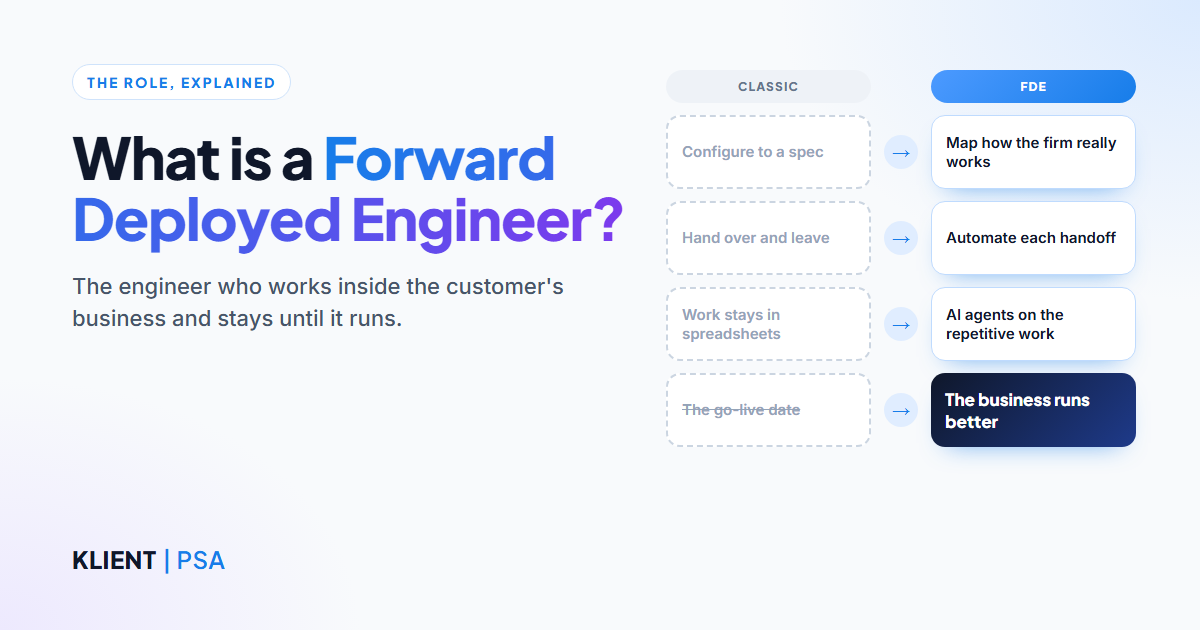
A forward deployed engineer (FDE) is an engineer who works inside the customer’s business, not at arm’s length from it. Instead of handing over software and a manual, the FDE learns how the customer really works, builds the software into that work, and stays until it delivers results.
The title used to belong to a handful of data companies. Now AI labs, Salesforce and its partners hire for it. The reason is simple: an AI agent is easy to demo and hard to put into production. Someone has to sit with the people who will use it and make it work in their day.
This guide explains where the role came from, who hires FDEs, how the role differs from a consultant, how FDEs measure success, and what the role looks like in the Salesforce ecosystem.
In one sentence: a forward deployed engineer is measured on whether the customer’s work runs better, not on whether the software went live.
Where did the forward deployed engineer role come from?
The forward deployed engineer role started at Palantir in the early 2010s. Palantir embedded engineers directly with its customers, many of them government agencies, to get its data platform working on real problems. Those engineers wrote code, but they wrote it next to the analysts who used it.
AI companies copied the model. OpenAI, for example, runs forward deployed engineering teams that embed with large customers to deploy its models and agents (The Pragmatic Engineer covers the history in detail). Salesforce now has its own FDEs for Agentforce, who work with customers to move AI agents from demo to production (Salesforce explains the role here).
How is a forward deployed engineer different from a consultant?
A forward deployed engineer owns the outcome inside the customer’s operation, while a consultant usually owns a scope of work and a go-live date. The two roles share skills. What differs is where they sit, what they ship and how success is judged.
| Role | Where they work | What they deliver | Success means |
|---|---|---|---|
| Solutions engineer | With the sales team, before the deal | Demos and proofs of concept | The deal closes |
| Implementation consultant | On a project, to a written spec | A configured system and trained users | The go-live date |
| Customer success manager | With the account, after go-live | Adoption plans and renewals | The customer renews |
| Forward deployed engineer | Inside the customer’s daily work | Automation built into how the team works | The business runs better |
In short, the FDE combines the engineer’s ability to build with the consultant’s ability to understand a business. Then they stay long enough to see the result.
What does a forward deployed engineer do day to day?
A forward deployed engineer spends the week turning how a team really works into software that does part of that work. The mix changes by company, but the pattern holds.
1. Watch the work
Sit with the people doing it. Find each handoff, who owns it and what “done” means.
2. Connect the data
Get the right records, permissions and integrations in place. Most AI projects stall here.
3. Build the automation
Configure flows, agents and integrations so the repetitive steps run without retyping.
4. Keep people on decisions
Decide which steps an agent drafts and which a person approves before anything ships.
5. Measure and adjust
Track the numbers the business cares about, then fix what the data shows.
6. Feed the product
Send what the field learns back to the product team, so the next customer starts further ahead.
What skills does a forward deployed engineer need?
A forward deployed engineer needs enough technical skill to build and enough business sense to know what is worth building. The role draws on five skills:
- Building skills. Code, configuration or both, depending on the platform. On Salesforce, admin and developer skills cover most of it.
- Data skills. Data models, integrations and security, because agents are only as good as the records they read.
- Process design. The ability to map a workflow and spot where time and money leak.
- Communication. Explaining trade-offs to a managing partner and a project coordinator in the same afternoon.
- Judgment about AI. Knowing when an agent can act alone and when a person must approve first.
Which companies hire forward deployed engineers?
Four kinds of companies hire forward deployed engineers today. They have one thing in common: their product only pays off once it runs inside the customer’s daily work.
AI model companies
They embed engineers with large customers to turn models and agents into working systems.
Data platforms
Palantir built the role to put its platform to work on real customer problems.
Enterprise software vendors
Salesforce uses FDEs to get Agentforce customers from demo to production.
Consulting partners
Partners build FDE practices to stay with a customer after go-live and grow the account.
The last group is the fastest way into the role for most people. A consulting partner already has the customers, the platform skills and the trust. What changes is the offer: from a project with an end date to an outcome the partner stays to deliver.
Why are companies hiring forward deployed engineers now?
Companies are hiring forward deployed engineers because AI agents fail in production for business reasons, not model reasons. The agent cannot find the right record. It lacks permission. Nobody decided who approves its work. Or the process it automates only exists in someone’s head.
None of these problems shows up in a demo. All of them show up in week two. An FDE closes that gap by working where the problems appear, with the people who have them.
The pattern: software vendors used to sell licences and leave adoption to the customer. With AI agents, the vendor or partner who stays and makes the work run is the one the customer keeps.
What does a forward deployed engineer look like on Salesforce?
On Salesforce, a forward deployed engineer puts a customer’s operation onto the Salesforce org they already own, then staffs AI agents on the repetitive work. Salesforce has its own FDEs for Agentforce customers. Salesforce consulting partners can run the same play for the firms they serve.
Professional services firms are a strong fit, because their whole business is handoffs. A deal closes in Sales Cloud. A project has to start. People need to be staffed, time logged and hours billed. Every handoff that runs on spreadsheets costs margin.
Klient PSA is a professional services automation (PSA) app built 100% natively on Salesforce, so the whole delivery cycle runs on the same records as sales. A partner working as an FDE can map the firm’s processes, turn won opportunities into projects, set up resource management, and give the firm’s AI agents for professional services their share of the work, with a person approving each action.
The result is what we call the firm’s Business Operating System: every process from the signed deal to the paid invoice, run by one platform every day. If you want the role and the six rollout steps in detail, read how to become a Salesforce forward deployed engineer with Klient PSA.
How does a forward deployed engineer measure success?
A forward deployed engineer measures success with the customer’s own business numbers, agreed before the work starts. Go-live is a step, not the finish line.
The right numbers depend on the business. In a professional services firm, four of them tell most of the story:
| Number | What it shows | Where it leaks | What the FDE automates |
|---|---|---|---|
| Days from deal to kickoff | How fast a sale turns into work | Scope retyped into another tool | The project is created from the won opportunity |
| Billable utilization | How much of people’s time is sold | Some people overbooked, others idle | Staffing from one live view of who is free |
| Unbilled hours | Work done but not yet invoiced | Timesheets chased on Friday | Time logged where the work happens |
| Time from timesheet to invoice | How fast work turns into cash | Billing rebuilt in spreadsheets | Invoices built from approved time |
These numbers matter because the margin is thin. According to the 2025 SPI Professional Services Maturity Benchmark, billable utilization averaged 68.9% in 2024, below the 75% that SPI Research considers healthy. An FDE who moves that number a few points pays for the engagement many times over.
What are the trade-offs of the forward deployed engineer role?
The forward deployed engineer role trades predictability for impact. It suits people who like seeing their work used the next morning, and frustrates people who want a clean spec and a quiet desk.
What people like
You see results in the customer’s numbers, not just in a ticket queue. You learn how a business really runs. Your skills travel across industries, and good FDEs become the person the customer calls first.
What is hard
Priorities change with the customer’s week. Much of the work is people and process, not code. And you own outcomes you do not fully control, such as whether a team changes how it works.
For a consulting partner, the same trade applies to the business. Projects with an end date are easier to scope. Staying until it runs is harder to sell, but it builds the recurring relationship that projects never do.
How do you become a forward deployed engineer?
You become a forward deployed engineer by pairing a building skill with time spent inside real customer operations. There is no single certification. These steps are the common path:
- Master one platform deeply. For Salesforce professionals, that means data model, security, flows and integrations.
- Learn one industry’s work. Pick an industry and learn how money moves through it, from deal to invoice.
- Take on outcome-based work. Ask to be measured on a business number, such as days to project kickoff, rather than a go-live date.
- Get hands-on with AI agents. Build one, give it a real task and design the approval step around it.
- Stay after go-live. The habit of staying until it runs is what separates an FDE from a consultant.
Salesforce consultants can start with Klient PSA training for Salesforce consultants, or explore the Klient partner program. If you want to understand the category first, start with what professional services automation is.
Forward deployed engineer FAQ
What does FDE stand for?
FDE stands for forward deployed engineer: an engineer who works inside a customer’s operation to build software into its daily work and stays until it delivers results.
What is forward deployed engineering?
Forward deployed engineering is the practice of placing engineers inside customer operations, so the software is built into how the customer works rather than handed over at go-live.
Is a forward deployed engineer a software engineer?
Usually, yes. Most FDEs can write code, but the role weighs business understanding as heavily as coding. On low-code platforms like Salesforce, configuration and process design make up much of the work.
What is the difference between a forward deployed engineer and a solutions engineer?
A solutions engineer works before the sale, building demos that help close the deal. A forward deployed engineer works after the sale, inside the customer’s operation, and is judged on whether the business runs better.
Can a Salesforce consultant become a forward deployed engineer?
Yes. Salesforce admin and consulting skills cover most of the technical side. The shift is in scope: owning a business outcome and staying after go-live, rather than delivering a configured org to a spec.
Want to see a Business Operating System running on Salesforce? Book a Klient PSA demo.