SCOPEY 1AI Business Analysis Agent for Salesforce
Bad requirements cost weeks. They cause rework, missed deadlines, and deliverables that don't match what the business needed. SCOPEY stops that at the source.
Stop building the wrong thing.
Every time.
SCOPEY 1 is an AI business analysis agent for Salesforce — powered by Agentforce and built into Klient PSA. It scopes tasks before work starts. You describe what you need. SCOPEY asks one clarifying question, writes the structured scope, and holds it for your approval. Nothing gets built without a human sign-off. Clear scope in. Rework out.
Why Scope Creep Is Killing Your Projects
The cost of poor requirements is not a theory. These numbers come from independent research across hundreds of PS organizations.
- 1.65 scope changes per project.
- 56% of firms handle them informally.
- 11.3% of projects overrun. Up 18% in one year.
Industry research cited above is drawn from independent studies. Numbers reflect industry-wide averages — individual results vary by team size, project complexity, and existing process maturity.
One Request In. One Scoped Task Out. Human Approved.
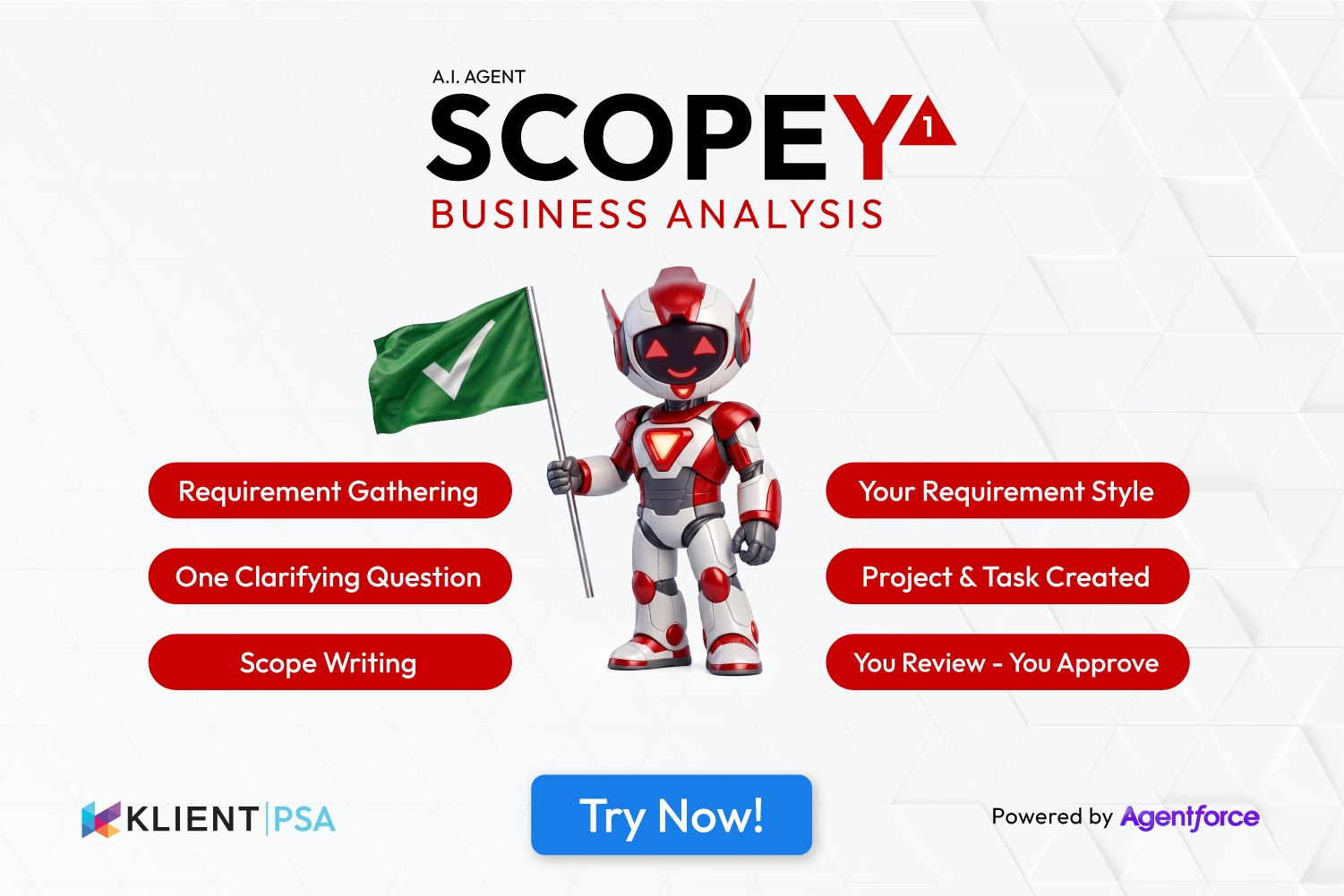
6 actions from plain language request to approved task. Nothing built until a human signs off.
SCOPEY 1 is a Salesforce Agentforce agent built into Klient PSA. It writes software requirements from plain language requests — with context, spec, edge cases, constraints, and acceptance criteria — for $1,000 one-time.
📥 Requirement Gathering — plain language in, structured scope starts
A team member submits a plain language software request — via a Klient PSA Custom Object record, a Slack message, or a Case. No template. No form. Just the request as they'd naturally describe it. SCOPEY receives it and immediately begins structuring.
❓ One Clarifying Question — before anything is written, ambiguity resolved
Before SCOPEY writes a single word of the requirement, it asks exactly one focused question. Not a requirements workshop. Not a list of questions. One question — targeted at the most critical ambiguity.
📝 Scope Writing — one request in, one complete scope out
One answer. That's all SCOPEY needed. Now it writes — and it doesn't stop at a title and a sentence. Every scope has four parts: Why it's needed, What it does exactly, What could go wrong, and What it must not break. The person who builds it has no excuses. Neither does the person who reviews it.
📋 Your Requirement Style — your structure, your rules, every time
No two businesses scope work the same way. A software consultancy doesn't write requirements like a product team. A fixed-fee project doesn't need the same sections as a T&M retainer. SCOPEY reads its instructions from the Agentforce Agent Resource — plus specific instructions you write in plain language, directly on the project record. No code. No configuration files. Just tell SCOPEY how you want it to write. That means every project type gets its own output structure. Your sections. Your labels. Your level of detail. SCOPEY follows your style — not a generic template.
🎯 Project and Task Created — requirement written to task, ready to assign
SCOPEY creates the tasks — one per scoped item, linked to the right project — with the full structured scope written directly into the task fields. The task is ready to pick up and work on. The next request can come in immediately — SCOPEY is already free for the next scope.
👁️ You Review — You Approve
Every Klient AI agent operates under a single principle: humans lead, agents deliver. SCOPEY scopes the work and creates the tasks — but you assign them. You read the scope. You decide who picks it up. You stay in the loop at every step.
That's Autonomous Project Delivery — and it starts with you in control.
Is SCOPEY 1 Safe to Run in My Salesforce Org?
SCOPEY 1 reads requests and writes structured documents — it never deploys code, modifies configuration, or triggers development tasks without human approval.
What Do People Ask About SCOPEY 1?
Does SCOPEY always ask a clarifying question?
Always — no exceptions. Even on a crystal-clear request, SCOPEY asks one question. Not because it's confused, but because one focused question consistently produces a tighter scope. It never asks more than one at a time. If the first scope isn't exactly right, you iterate — give SCOPEY feedback, it revises. One question per round, until the scope is exactly what you need.
What does the scope output look like?
SCOPEY ships with a default style — no setup required. Two levels of customization on top: company-wide instructions in the Agent Resource, and project-specific instructions per project record. A fixed-fee implementation can follow a different structure than a T&M retainer. Both in plain language. No code.
Does SCOPEY write code or assign tasks?
No to both. SCOPEY scopes the work and creates the tasks — scope written directly into the task fields. You assign them. What gets built from that scope is a human decision, not SCOPEY's.
Can one request create multiple tasks?
Yes. If the scope covers multiple pieces of work, SCOPEY creates a task for each — all linked to the right project, all with the scope written to their fields. You review the full picture before anyone picks up a single task.
Is SCOPEY 1 a subscription or one-time?
One-time. $1,000 USD once. The only ongoing cost is Salesforce Flex Credits — approximately 20 per execution. One execution = one scoped task, end to end. Credits are purchased directly from Salesforce. Confirm current rates with Salesforce — pricing is governed by your agreement.
What types of requests can SCOPEY handle?
Anything you can describe in plain language — via Klient PSA Custom Object record, Slack message, or Salesforce Case. Field additions, workflow changes, UI adjustments, integration logic, automation requirements. If your team can describe it, SCOPEY can scope it.
